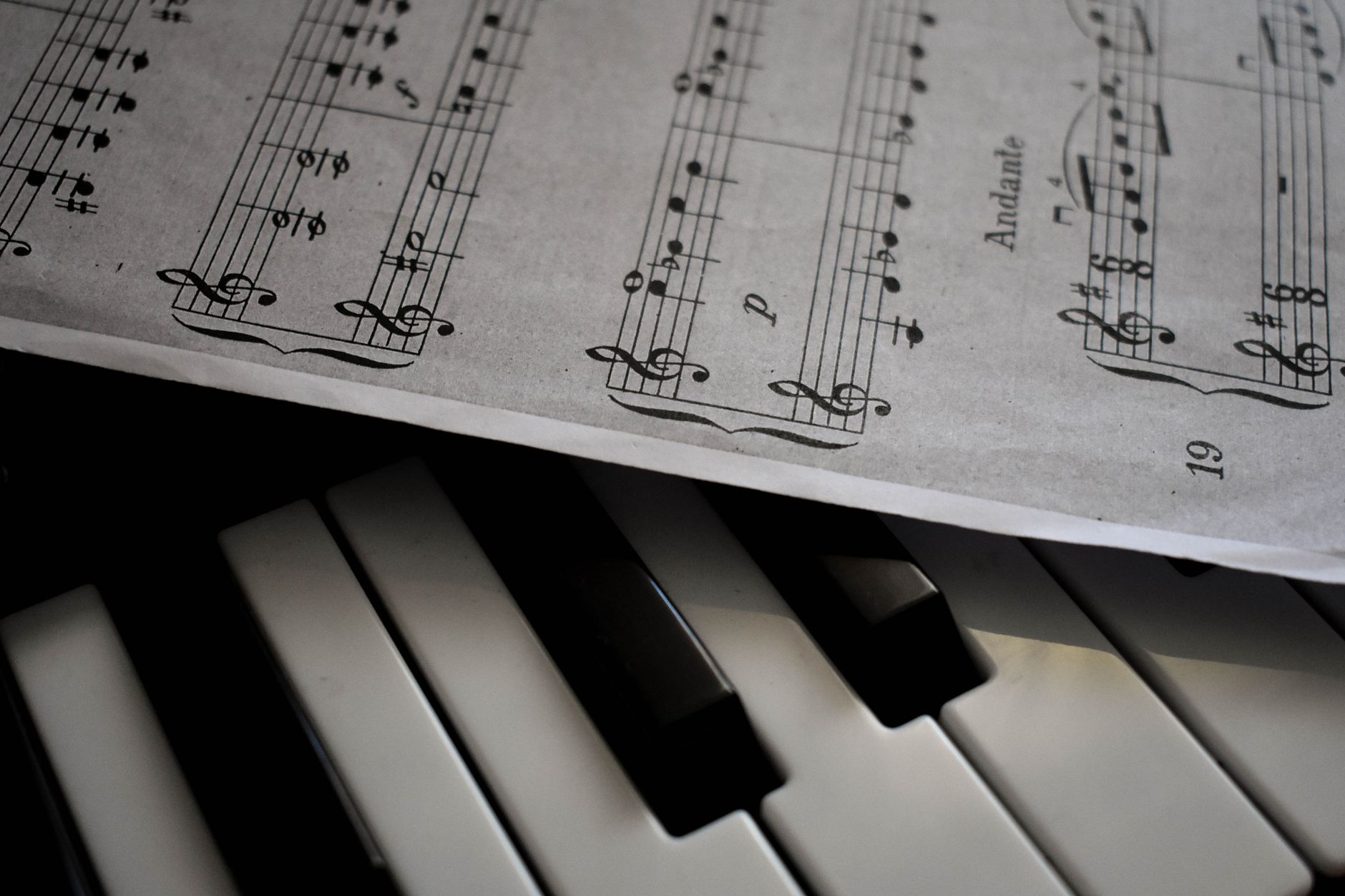
Andante is a tempo marking in music, directing performers to play at a moderate, steady walking pace. It comes from the Italian verb andare, meaning "to go" or "to walk," and the connection to physical movement is exactly the right mental image. A piece marked andante isn't slow in a heavy or dragging way. It moves with easy, purposeful steps.
What andante means precisely
In musical notation, andante sits on the tempo spectrum between adagio (slow and stately) and moderato (moderate). Metronomically, it corresponds roughly to 76 to 108 beats per minute, though the boundaries shift depending on the era and the composer. Baroque composers used the word more loosely than the Romantics, who attached increasingly precise metronome values to their markings.
The Italian root tells you almost everything. "Walking" is not a vague instruction. It implies forward motion with a natural, unhurried rhythm. A performer reading andante understands they should keep things flowing rather than lingering. The tempo has weight but not drag.
Related words sharpen the meaning further. Andantino is the diminutive form and, counterintuitively, can mean either slightly faster or slightly slower than andante depending on context and period. Andante con moto adds the phrase "with motion," pushing the energy a notch higher within the same general tempo band.
Andante in classical music
The word appears throughout the Western classical repertoire, most often as a movement title or a tempo directive. Mozart labelled the second movement of his Piano Concerto No. 21 "Andante," and that movement became one of the most recognisable pieces of music of the 18th century. Beethoven used the marking in multiple symphonies and sonatas, typically to create breathing room between more dramatic outer movements.
Schubert's String Quintet in C major opens its second movement with an Andante con moto instruction that has earned the movement a reputation as one of the most emotionally direct passages in chamber music. The marking tells performers exactly what's needed: forward movement, but nothing rushed.
In orchestral contexts, andante movements often carry the expressive weight of a work. They're where composers tend to place lyricism, intimate themes, and harmonic colour that faster movements don't have room for.
Andante outside classical music
The word migrated beyond the concert hall long ago. Writers use "andante" as a literary adverb or adjective to describe any action that moves with measured, unhurried purpose. A prose style can be described as andante if it unfolds steadily without rushing toward its point. A conversation can proceed andante when neither speaker is in a hurry.
Film composers also use the marking in scores. A scene scored andante typically signals reflection, calm, or a deliberate slowing of the emotional pace. The word does real descriptive work because it implies not just speed but character: steady, human-scaled, walking.
Just as a word like zeal carries its own force beyond its dictionary entry, andante carries the feel of the thing it describes. Say it aloud and the tempo is already in the sound.
How to use andante correctly
In a musical score or programme note, andante stands alone as a tempo marking, capitalised at the start of a movement. In prose, it functions as an adjective or adverb and is typically italicised when used as an Italian loanword, though many style guides now accept it in roman type since it appears in most English dictionaries.
Use it when you want to convey measured, calm, deliberate movement. Don't use it to mean simply "slow." Slow suggests reluctance or heaviness. Andante suggests intention and ease. The distinction matters.
- As a tempo marking: "Andante (♩= 84)" appears at the top left of the movement.
- As an adjective in prose: "The lecture unfolded at an andante pace, each idea given room to settle."
- As an adverb: "She walked andante through the gallery, stopping where something caught her eye."
Andante compared with neighbouring tempo terms
Musicians learn tempo words as a rough continuum from slowest to fastest. Largo sits at the slowest end. Grave is slow and solemn. Adagio is slow but more lyrical. Then comes andante, followed by moderato, allegretto, allegro, vivace, presto, and finally prestissimo at the extreme fast end.
Andante's position is not arbitrary. It occupies the tempo of natural human walking, which is why conductors and performers hear it as a reference point rather than a compromise. It's a baseline against which faster and slower markings pull in either direction.
That grounding in physical movement is what makes andante more than a technical instruction. It's also why the word translates so cleanly into non-musical writing. The walking metaphor carries built-in information: purposeful, embodied, and paced for a human being. Words that carry that kind of precision are worth knowing. Much like the adjective conducive, which does specific work that "helpful" can't always replicate, andante fills a gap that "slow" and "moderate" leave open.
Origin and history of the word
Italian became the dominant language of Western classical music notation during the 17th century, when composers across Europe adopted the conventions of Italian opera and instrumental music. Tempo words from Italian carried authority partly because the form itself originated there. By the early 18th century, andante appeared regularly in printed scores from German, Austrian, French, and Italian composers alike.
English borrowed the word through the musical tradition and it's now listed in standard English dictionaries including Merriam-Webster, where it appears as both an adjective and an adverb. Its entry in the language is secure enough that many writers no longer feel obliged to italicise it, though musical contexts still tend to.
The word's durability comes from the fact that Italian walking pace was a real, agreed-upon human speed. Metronomes didn't exist when the marking first appeared. Composers and performers had to share a common reference. Walking was universal.